 Typical

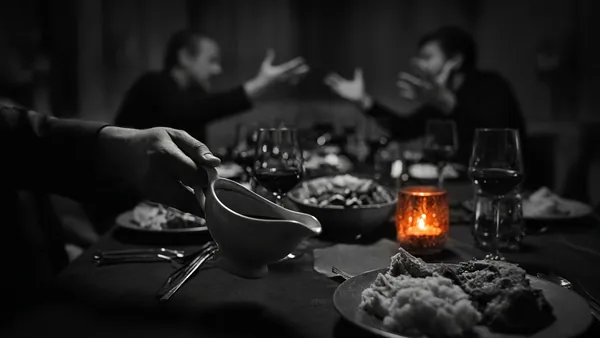
Every family has an unpaid referee. She doesn't get a whistle or a title. She gets a seat in the middle of the table and a sore jaw by four o'clock.
In most families there's a person whose job is to keep the peace. They change the subject. They catch someone's eye across the table. They refill a glass at exactly the right second. If you're reading this, it might be you.
This is how to keep politics off the table without making the whole day your shift.
You're not obligated to win the argument. You're allowed to protect the person.
The table is braced
You aren't imagining the tension. YouGov's 2025 survey found 31% of Americans expected to discuss politics at Thanksgiving. In Savings.com’s Thanksgiving study, 58% planned to avoid it, 71% planned to dodge at least one topic, and 31% named family conflict as a holiday stressor.
And the fight isn't always across party lines. YouGov found most people expected to celebrate mostly with people who voted the way they did: 45% of Harris voters and 44% of Trump voters said almost all their guests backed the same candidate. Still, 19% of Democrats and 9% of Republicans expected an argument. Families find a way.
Should we just talk about it?
There's a fair case against the ban. Some women are tired of being told to keep things pleasant while someone at the table says things that affect their lives. Silence can feel like agreement, and peacekeeping can feel like erasing yourself. Some families genuinely enjoy a good argument and come out closer.
The case for keeping it off the table is about the venue, not the topic. A holiday dinner has an audience, alcohol, fatigue and a cook who'd like to eat in peace. Very few people have ever been persuaded between the turkey and the pie. You can hold your views and still decide this isn't the room for them.
Share the job before the day
Peacekeeping becomes invisible labor when one person does it alone. Ask the host to set a simple norm ("no politics at the table this year") so it isn't your job to enforce. Ask your partner or a sibling to be the second set of hands: if it starts, they change the subject, not you.
Scripts
"I love you, and I'm not doing this one today." "Can we save that for a phone call? I want to hear about your trip." "Let's not, it's Grandma's day." Then redirect with a real question, not a weather question. People can't argue and tell a story at the same time.
Signals
Agree on a phrase with your partner that means "get me out of here," and on a phrase that means "I've got it, stay." Use them.
Three scenes, three moves
The jab at you. "Bet you've got opinions about that." You can decline: "I do. Not today. How's the new job?"
The jab at someone else. A cousin's partner, a sibling's choices, someone's identity. That's when you step in once, calmly: "Not about him."
The spiral. Two relatives are already in it. Don't jump in to mediate; that's how the referee job is born. Stand up, start clearing plates and ask one of them to help you in the kitchen. Movement breaks a loop faster than words.
When it's not politics anymore
If a comment targets someone at the table, their identity, their relationship, their body, that's a different conversation. You can say once, calmly, "Not about her," and move on. You're not obligated to win the argument. You're allowed to protect the person.
And let yourself off duty
If you're the family peacekeeper, try this: let one awkward silence go unfilled. Somebody else might fill it. If nobody does, the table will survive the silence.
Typical Male's guide is for the guy who always takes the bait, and how he learned to stop: How to Avoid Politics at Thanksgiving Without Pretending You Have No Opinions.
Frequently asked questions
How do you avoid politics at Thanksgiving dinner?
Ask the host to set a no-politics norm before the day, recruit a partner or sibling to share the job of redirecting, keep a few scripts ready and change the subject with a real question.
Why do women so often end up keeping the peace at family dinners?
Peacekeeping is emotional labor, and it tends to fall on whoever is most attuned to the room. Savings.com’s study found emotional labor, including cooking, hosting and managing family dynamics, now rivals financial stress as a leading Thanksgiving burden.
What can I say to shut down politics at the table?
"I love you, and I'm not doing this one today." "Can we save that for a phone call? I want to hear about your trip." Keep it warm and short, then redirect.
What if a political comment is about someone at the table?
Then it's not really politics anymore. You can say once, calmly, "Not about her," and move on. You don't have to win the argument to protect the person.
Your turn
Ban politics at the table, or talk it out? Pick a side below, and send us the script that works in your family.
Sources
YouGov, "Thanksgiving 2025: what Americans will cook, eat and debate at the table this year" (n=1,120) · Savings.com, Thanksgiving trends study (n=2,502)